

Yes, you can add accessories to a metal frame watch showcase. The frame is rarely the problem. A stainless tube frame carries more load than most people expect, and the parts that fail are usually the ones nobody planned for: a shelf that was never rated, a driver screwed to the back panel, a mirror glued on instead of fixed.
We build these units and we also retrofit them for retailers who bought elsewhere. These are the additions that work and the ones that come back to us.
What the frame will take
Grade 304 stainless box section is the common choice and it handles extra hardware without complaint. What it does not like is load applied to a point. A 25 kg shelf spread across four brackets is fine. The same weight hanging off two self-tapping screws into a 1.2 mm wall is not, and the panel will bow within a season.
For heavier fittings, use rivnuts or a through-bolt with a backing plate rather than a screw into thin sheet. Ten extra minutes per fixing keeps the display square.
Lighting inside the case
LED strip is the first thing most clients ask for, and it is also where most retrofit faults come from. Two rules cover it.
Keep the driver out of the display compartment. Heat shortens driver life, and a driver sitting behind a back panel near the watches is a warm spot you do not need. Put it in the base or in the plinth.
Choose the colour temperature to suit the product. 3000K for gold cases and warm dials, 4000K for steel and white dials. A 6000K strip on a warm dial makes the metal look grey, which is the opposite of what a watch counter is for.
Run the low-voltage cable in a channel, not across the back of the shelf. It is the single cheapest detail to get right and the one most often skipped.
Trims, mirrors and finishes
Wood trim along the edges of a metal frame softens it and takes the showroom look off. A 20 mm solid oak or walnut edge band is enough. Any thicker and the frame starts to read as a timber cabinet with metal legs.
Crystal or glass accents work if the watches are ornate and the price band is high. On a clean minimalist collection they look like decoration added afterwards, which is what they are.
A mirror at the back is the most useful accessory per dollar. A 4 mm mirror makes a shallow case read deeper and lets a customer see the case profile of a watch without asking staff to take it out. Fix it with mirror adhesive plus mechanical clips. Adhesive alone lets go in a warm shop after a couple of years, and a falling mirror over a watch tray is a bad afternoon.

Security add-ons
Alarm contacts and glass break sensors are worth fitting if the counter holds pieces above a certain value. The sensor goes on the inside of the glass, the contact on the frame, and both need the cable route decided before the panel is closed up.
The awkward part is that security hardware is often specified after the showcase is built. A door contact needs a pocket in the frame. If the frame is already welded, you are drilling it on site and hoping the swarf does not end up on the velvet.
Installation is where it goes wrong
Most accessory problems are fixing problems. A shelf fitted by someone who has not done it before sits out of level, the watches slide, and the client blames the showcase.
If you are not confident with a drill and a level, pay someone who is. A good fitter will also tell you when an accessory is a bad idea.
Balance and budget
Two practical limits. Access: a case packed with plinths, risers and props leaves no room for a hand, and customers stop picking things up. Leave at least 100 mm of clear space behind the front glass.
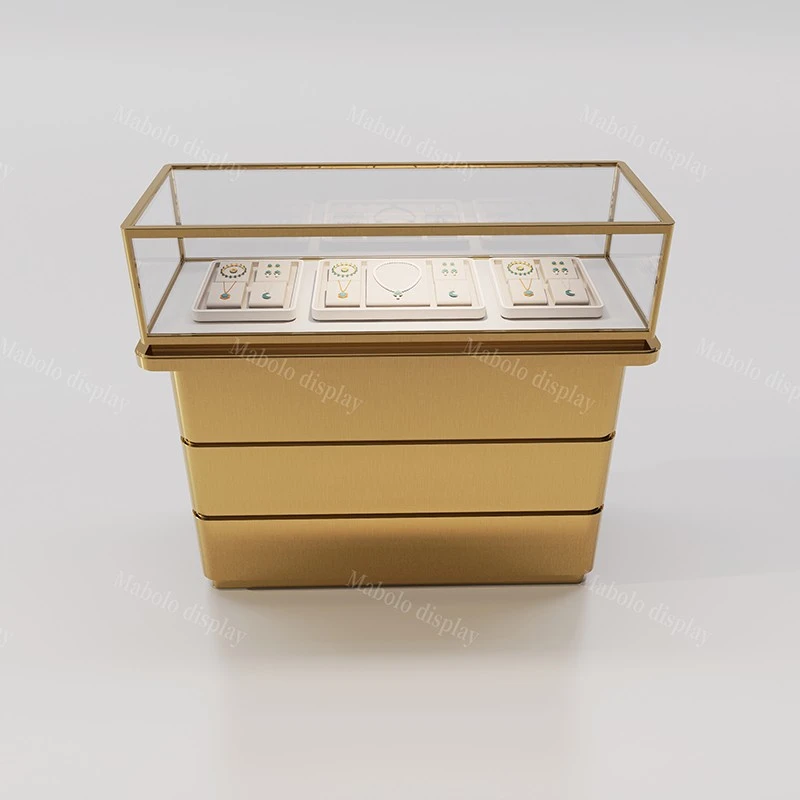
Our own metal frame range starts with the Stainless Steel Watch Display Cabinet, which is built around a 304 frame and takes accessories without modification. The Marble Watch Display Counter pairs the same frame with a stone top, and the High End Luxury Watch Display Showcase is the version we build for the top price band, with the lighting and security pockets already in the drawing.
Tell us what you want to add and send a photo of the frame. We can usually say within a day whether it will take the load or whether the accessory needs a different fixing.