

The number you need is per shelf, not per case. Suppliers quote one figure for a Countertop Museum Showcase, and that single figure hides the part that fails first: the glass shelf and the four points holding it up.
We build countertop cases for regional museums, private collectors and a handful of gallery shops. The load question comes up in nearly every enquiry, and the honest answer is that the case itself is rarely the weak link. What the case stands on usually is.
What sets the limit on a countertop case?
Span matters more than thickness
A 6 mm tempered shelf across a 400 mm span will bow visibly under a 20 kg bronze. Move to 8 mm on the same span and the deflection drops by more than half. Put a centre rail in, shorten the span to 300 mm, and you gain more again than another 2 mm of glass would give you. Deflection rises with roughly the cube of the span, which is why the width of the case is the first thing we ask about, not the weight.
Frames and shelf supports
Frames are usually 304 stainless or 6063 aluminium. Both carry museum loads without trouble. The joints are where the difference shows: a welded stainless corner ground flat holds far more than a bolted extrusion closed with a plastic block. Shelf pins deserve the same attention. A 5 mm pin sitting in a 6 mm hole is a point load on a glass edge, and that is where chips start.
What the case stands on
Countertop cases spend their lives on 18 mm oak veneer tables, not on steel benches. A 60 kg case on four small feet will leave dents in a veneered top within a season, and a table with a slight twist will rack the case and load one corner of the glass. A continuous base rail or a spreader plinth solves both, and costs very little at the drawing stage.
How do these cases fail in practice?
Three ways, in our experience. Someone loads the middle of a shelf because it photographs better. An edge gets chipped during installation and nobody writes it down. Or the case is shifted with the shelves still inside and a pin shears.
None of those are material failures. They are handling failures, and they are cheap to design out: a polished edge on every shelf, the pin size printed on the asseMaboloy sheet, and a line on the crate telling the installer to take the shelves out before lifting.
How do you work out the real load?
Weigh the objects, then add everything that gets forgotten. Mounts and plinths, label holders, a liner, a glass dome. A 4 kg ceramic on a 2 kg acrylic mount with a 1 kg base is a 7 kg item, and three of those on one shelf is a very different case from the one you specified.
Then leave margin. A shelf run at 60 percent of its calculated limit will still be flat in ten years. One run at 95 percent will not. Spread weight along the span instead of clustering it, and put the heaviest object over a support rather than mid-span.
- Ask for a load figure per shelf, not one number for the whole unit.
- Ask what span that figure was calculated at.
- Ask whether the shelf itself is included.
- Ask what the rating becomes once castors are fitted.
A supplier who can answer those four without leaving the room knows the product.
What else matters besides load
Security first: a lockable lid or front panel, and hinges that cannot be lifted off their pins. Then visibility, which is why most of our countertop units use low-iron glass rather than standard float. Access matters more than clients expect. You will clean the inside far more often than you think, and a lid that needs two people to hold it open gets cleaned less often than one with a stay.

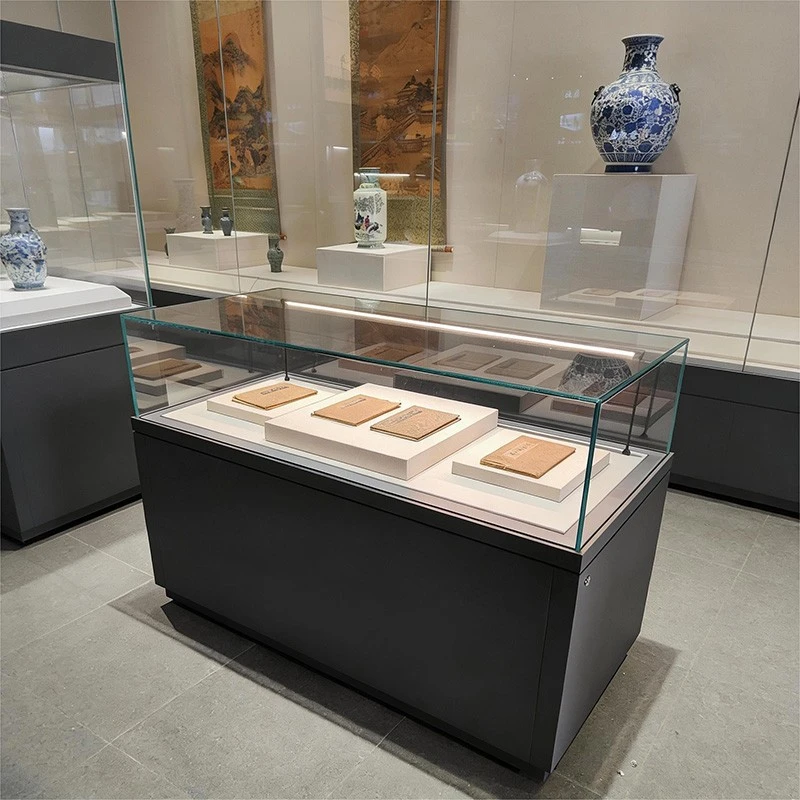
For small, precious pieces the Countertop Museum Showcase is the sensible starting point. Taller objects suit the Museum Pedestal Display Cases with Ultra-clear Glass, and if the room is dusty or the case will be moved between galleries, the Stainless Steel Museum Showcase takes knocks better than a veneered body.
Send us the object list with rough weights and a photo of the table it will stand on. We will come back with a per-shelf rating, the span it was calculated at, and the frame specification behind it.