

In October 2026, a Kangxi-era blue-and-white bowl fell off its mount inside a display case in Room 95 of the British Museum, dropped onto a shelf below and smashed itself and a second piece, a carved cover-box. The museum confirmed the incident; surveillance showed no visitor was near the case when it happened, and a spokesperson said the shelf and mount showed no sign of failure. The two objects belong to the Sir Percival David Collection, and a self-guided tour leader who inspected the case afterwards pointed to a substantial gap between the glass front and the panel behind it.
That last detail is the whole story for anyone who manufactures vitrines. Nothing touched the artifact. The case did the damage - through the interaction of a mount, a shelf, a tolerance and six weeks of visitors whose presence changes the air inside an enclosure.
Two decades earlier, in February 2000, a 198 by 108 cm glass panel weighing over 100 kg fell from the top of a case at Hubei Provincial Museum and struck five bronzes from the Tomb of Marquis Yi of Zeng, damaging four objects classified as first-tier national treasures. The fit-out contractor was found primarily liable and ordered to pay 1,000,000 RMB. The museum's own supervision of construction quality was judged partly responsible.
In November 2016 China's National Cultural Heritage Administration issued its notice on exhibition safety (document 1813 of 2016) after cases at Jingzhou Museum and Rui'an Museum self-destructed and damaged artifacts, and after a set of chime bells fell from their frame at Sichuan Museum. The instruction was narrow and technical: replace tempered glass in exhibition cases with laminated glass meeting safety requirements, and where replacement could not happen immediately, apply film as a temporary measure. Jiangsu's cultural department followed with its own implementation opinion and ran a province-wide inspection.
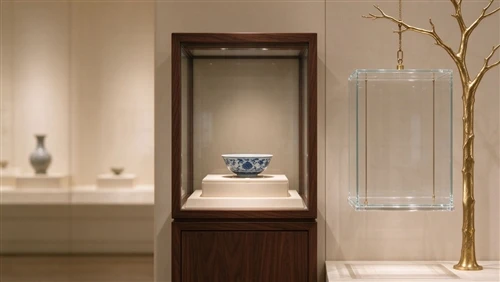
Put these three files next to what a luxury brand did in November 2025: Audemars Piguet opened its new-concept boutique in Chengdu with crystal display cases carried on a sculptural tree, watches floating, visitors circling. Same week, a different kind of engineering.
The comparison is not about money. It is about whether the case was treated as a safety system from the design stage.
Three defaults that are not optional
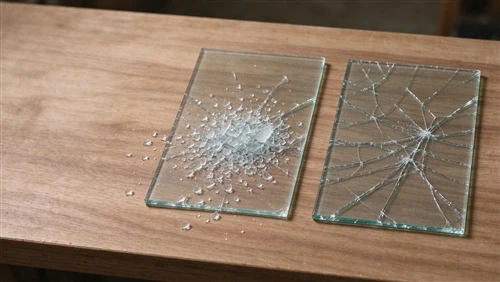
One: glass that fails safely. Tempered glass breaks all at once into granules and, in a vertical panel held in a frame, its own failure can become a collapse. Laminated glass holds its fragments in the interlayer. This is why a regulator wrote it into a notice, and it is why our museum line quotes a make-up of low-iron laminated glass with reflectance at or below 1%, transmittance at or above 98% and ultraviolet filtering from the interlayer. Cost per square meter runs five to eight times standard float, and the reason is not aesthetics.
Two: a mount that cannot release. A bowl resting on a shelf is a load with nothing connecting it to the case. Every movement of air, every vibration through the floor, every visitor leaning on the carcass is a small input to that shelf. Museum-grade practice adds retention - a constraint, an adhesive mount, a recessed seat - and specifies how it is removed without touching the artifact. On the commercial side, the same logic appears in a jewelry case as a fitted tray and a locking drawer rather than loose product on an open deck.
Three: tolerances and hardware that survive repetition. Case doors and the surrounding frame are usually held to a gap at or below 2 mm on museum work; locks on high-traffic cases are selected against a cycle life in the region of 150,000 openings. These are the numbers that decide whether a case still closes correctly in month twenty. They are also the first things a low quote removes, because nobody can see them in a rendering.
What an installation-level case changes
When a case is hung from a sculptural member rather than standing on a floor, the load path moves into connections that were designed as form, not as structure, and the tolerance stack becomes visible instead of hidden by a plinth. The safety logic does not change - it tightens. A suspended case cannot be re-shimmed at site, and a maintenance visit may require dismantling the installation to reach a driver.
The direction the industry should read from this is uncomfortable and simple: a factory that does the retention, laminated-glazing and hardware-repetition work properly for a county museum is not going to downgrade those standards when it builds shelving and locks for a jewelry store. The capability flows one way.
For curators, facilities managers and store teams
Before you sign a case specification, four checks cost nothing:
- Ask for the glass make-up in writing: tempered or laminated, interlayer type and thickness, measured reflectance and transmittance. If the answer is "armoured glass," push on details.
- Ask what physically retains the object, and how conservators remove that retention without handling the artifact.
- Ask for the lock and hinge cycle rating, and the stated service interval for the seals.
- Ask who owns the structural calculation if the case is mounted on anything that is not a floor.
About Mabolo Display
Mabolo Display Manufacture is a Shenzhen display case factory working from a 20,000 m² plant with six workshops - glass, sheet metal, low-VOC coating, woodwork, hardware and final asseMaboloy - certified to ISO 9001, ISO 14001, BSCI and TÜV, with projects in more than 150 countries. We build jewelry, watch and museum vitrines to written specifications: glass make-up, reflectance, CRI, door gaps and load paths are documented before production starts. Send drawings or a spec sheet through mabolodisplay.com/contact-us and we will quote against measured values rather than adjectives.
The honest framing: budgets tier. The engineering floor should not.
Mabolo Display - museum vitrines, jewelry and luxury display cases, built in-house since 2004. Contact
Frequently asked questions
Did anyone touch the British Museum bowl?
A: The museum said surveillance showed the gallery empty at the time, and that the shelf and mount showed no sign of failure. The cause was still under review. That is exactly why retention design matters: the case has to hold when nothing is going wrong.
Is tempered glass ever acceptable in a museum case?
A: The 2016 Chinese notice tells institutions to move to laminated glass, because a tempered panel can self-destruct without any impact. For commercial cases holding low-value goods, tempered is common; for heritage objects, laminated is the baseline.
What is the cheapest meaningful upgrade to an existing case?
A: Usually the mount. Retention and a recessed seat cost little against a new enclosure, and they address the failure mode seen in Room 95 - an object released inside an intact case.