

Watch Showcase Lighting: What to Specify Before You Sign Off the Counter
Two boutiques ran the same watch on separate counters. One sold within a week; the other discounted the piece after a month. Same watch. Different lighting.
Most retailers leave showcase lighting to the fit-out budget and, ultimately, to whoever installs it. In practice that decision shapes the sale, because the customer is inspecting a 38 mm dial, a brushed bezel and a hand-stitched strap from about 40 cm away. At that distance the light is doing as much selling work as the cabinet. This notes what a specification should actually cover.

Where Lighting Kills the Sale
Three failures show up again and again:
- Washed-out dial. Overpowering light flattens a sunburst or grained dial until it looks like printed plastic rather than a finished component.
- Mirror glass. Downlights and windows reflect off the front pane, the customer sees their own face instead of the watch, leans back, and the inspection is over.
- Wrong metal temperature. Yellow gold under cool light reads pale and cheap; steel and platinum under warm light look brassy and used.
None of these are product problems. All three get decided at specification stage, long before anything is wired up.
CRI - and the R9 Number Most Specs Leave Out
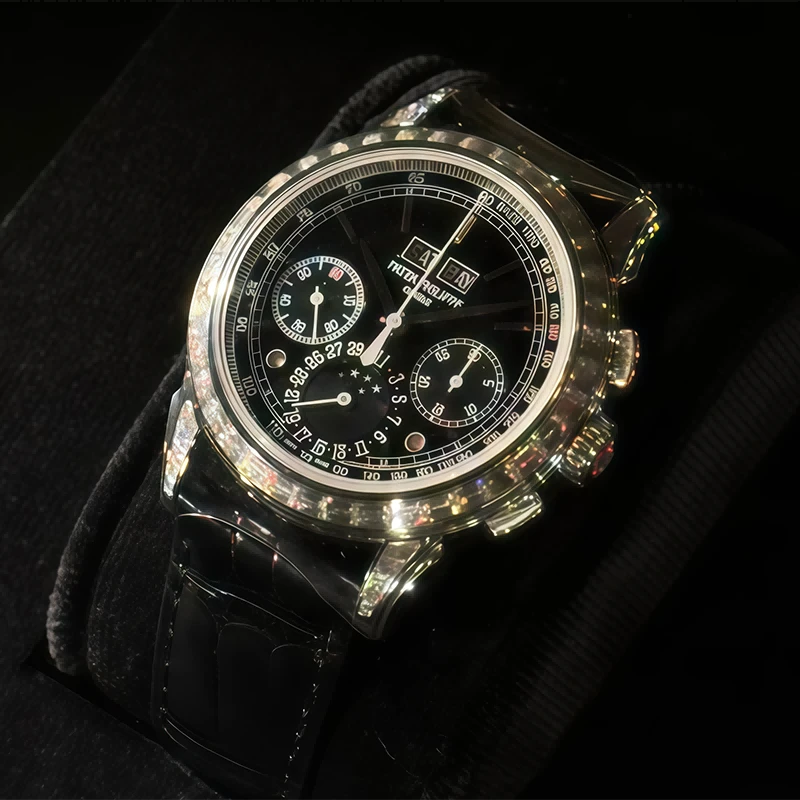
Color Rendering Index measures how faithfully a source shows color against a reference. Retail fixtures are commonly supplied at Ra 80 or Ra 90. On a watch, the jump to Ra 95+ is easy to see: blue and green dials keep their actual hue instead of greying out; mother-of-pearl and aventurine show the iridescence you paid for; gem-set bezels regain saturation; rose gold and champagne stay warm; lume and printed indices keep their contrast so the customer doesn't have to tilt the case.
There is a second number worth asking for: R9, the saturated-red sample. Watches rely on red accents - second hands, gilt text, red lacquer, gem-set dials - and a strip can measure Ra 90 while still doing badly on red. Write R9 into the RFQ. It costs nothing now and saves the afternoon you spend opening boxes later.
CRI ≥90 on Mabolo Display watch showcase strips as standard; the full plan is signed off at CRI 95+ during engineering, before production. Lighting plans are built this way because the alternative we keep inheriting from retrofit jobs is a finished cabinet with portable spotlights taped over it.
Color Temperature: Match to What's in the Case
There isn't one correct temperature for a watch counter. The working ranges used on high-end jewelry and watch projects:
- Diamonds and gemstones: cool white, 5500K–6000K. Higher temperature maximises fire and keeps gem colors pure.
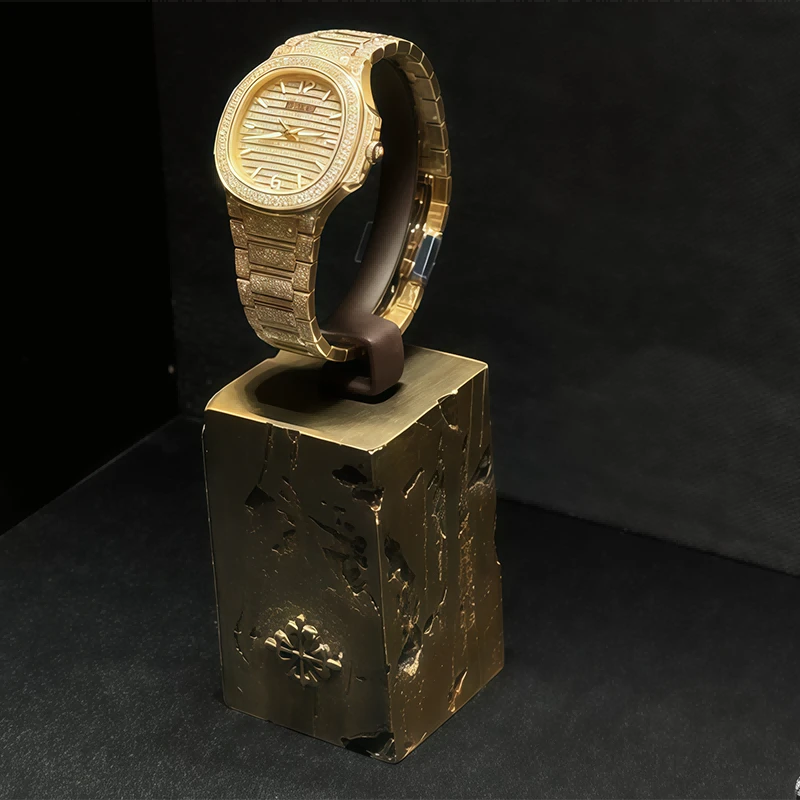
- Gold and rose gold: warm white, 3000K–3500K. Under cool light gold reads pale.
- Steel, titanium, platinum with dark or blue dials: neutral white around 4000K - clean metal, real dial color, no cast.
Skip fluorescent entirely; the cool tone and flicker flatten perceived value straight away. For a mixed counter - steel sports models beside gold dress watches beside a gem-set piece - tunable white, or per-niche sources, works better than a compromise temperature. Decide this before the cabinet sections are dimensioned, not during installation.
Beam Angle, Intensity and Layering
The detail most often skipped:
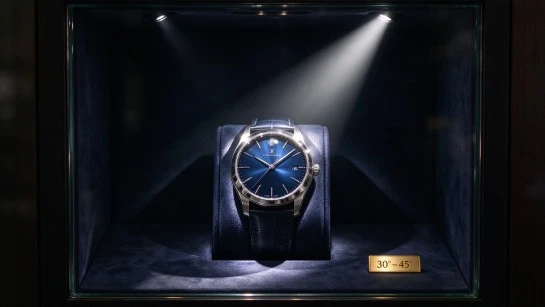
- 30°–45° beam angle for in-case spot sources. This throws a natural light pool on the product and keeps the beam off vertical, where it would bounce straight back out of the glass into the customer's eyes.
- Intensity matched to material. Diamonds and polished bezels need higher intensity to show brilliance; pearls, lacquer, patinated dials and leather straps need softer, diffused light or the surface loses its luster.
- Layering, not uniformity. Give the hero piece the brightest, most concentrated beam and let everything else sit in low-intensity ambient. Contrast is what reads as value - under flat, even light a CHF 30,000 watch and a CHF 300 watch look alike.
Precise illumination with clear layering: guide the eye, don't flood the box.
Anti-Glare: Four Sources, Four Fixes
Glare is whatever the customer sees instead of the watch.
Sources:
- The glass itself. Ordinary float glass reflects about 8% per surface, so a single pane returns roughly 16% as a mirror image. Low-iron glass cuts that; museum-grade anti-reflective laminate gets it near 1% per surface - at a visible premium.
- Overhead store downlights hitting the case at the mirror angle to the viewer.
- In-case light sources placed at vertical incidence.
- Glossy interiors - polished bases, mirrored trays, chrome risers.
Fixes:
- Low-iron ultra-clear tempered glass for viewing panels; anti-reflective laminate where the budget supports it on high-value niches.
- Light inside the case, off-axis, at an angle whose reflection misses the viewing position. That is the whole reason for the 30°–45° rule.
- Matte interiors. Velvet, suede and matte lacquer absorb stray light rather than bounce it - same reason velvet lining both protects a watch and makes it read better.
- Contrast between case interior and store floor. If the room is as bright as the case, the case disappears; design ambient light so the display is the brightest object on the customer's sightline.
Cold Light, UV and Care of Stock
Watches aren't inert. Strap leather, alligator and suede dry and degrade under heat and UV; lubricants thicken; dial lacquer and lume discolor over long exposure. Specify cold LED at the product plane, UV-filtering laminated glass on the front panels, and give hero pieces rest periods - especially in windows running continuously. Rotate the stock rather than leaving one dial under full intensity for months. A retailer protects margin on the item; a brand running window displays protects consistency between stores.
What to Put in the RFQ
Copy these five lines into your RFQ and you'll fairly quickly see which suppliers can actually respond:
| Parameter | What to require |
| CRI | ≥95 Ra, with R9 stated - not just Ra |
| Color temperature | Fixed per product group, or tunable white 3000K–6000K on mixed counters |
| Beam angle / placement | 30°–45°, off-axis, no vertical incidence on viewing glass |
| Glass | Low-iron ultra-clear tempered, safety-certified; anti-reflective laminate for high-value niches |
| Service & warranty | Strips and drivers replaceable without opening the case, flicker-free drivers, stated warranty period and after-sales response |
On the last line - service is also why Mabolo kept manufacturing in-house. When glass, metal, wood, coating, hardware and asseMaboloy sit under one roof, the lighting is engineered as part of the cabinet, not retrofitted into it. Five-point inspection before shipment, a two-year warranty and 24-hour after-sales support are what keep a lighting spec working in year three.
Twenty Minutes to Test Before You Order
- Bring a watch you own - ideally one with a blue or green dial and one in gold.
- Ask to see it in a lit sample case, not a rendered image.
- Photograph it from the customer's viewing distance with your phone. Flicker shows up on screen even when your eye misses it.
- Stand where a customer would stand and look at the glass at an angle. If you see your own face, the reflection geometry is wrong.
- If the room has a Ra 80 shop light, compare against it. It's the cheapest A/B test in retail and the one most owners never run.
If a supplier can't show you a lit sample or won't state R9, that's a brochure you're buying.
Common Questions
Is 95+ CRI worth the premium?
On metal, gem-set bezels and colored dials, yes - it's what separates a watch reading as finished from reading as generic. The premium sits in the strips, not the cabinet.
Why does my counter look worse than the brand's own boutique?
Usually layering rather than lamp quality. Uniform light with no hero beam flattens everything.
Can existing cabinets be upgraded?
Often. Strips, drivers and diffusers are replaceable; the limits are the glass, which can't be retro-coated, and any fixed optics.
Does brighter sell more?
Correct contrast sells more. Overpowering light destroys dial texture and creates glare.
Fitting Out a Watch Counter?
Start with the product, not the catalog. Mabolo Display designs and manufactures custom watch showcases in-house - 22+ years in the trade, projects delivered across 150+ countries, lighting plans signed off at CRI 95+ before production. Qualifying projects get a free 3D rendering with material direction and a budget estimate.