


Ask ten store owners where the best case should stand and nine point at the window. Passers-by are out there, so it feels right. It wastes the first three seconds a stranger gives you.
A jewelry store is five zones, not one room with cases in it. Each answers one question: keep walking in, stop walking, come closer, let me try it on, and one more thing before you pay. Every figure below is recommended practice, not a code requirement.
The five zones, in walking order

Zone 1 - Entrance transition: pull people in, do not price them out
The first 1.2–1.8 m inside the door. Put one low case to one side of the doorway axis, 900–1,100 mm long, top near 750 mm, open trays or light glass. Entry-price pieces, new arrivals, gift items. Nothing that needs a seat to look at.
Its job is entry volume, not revenue. A stranger needs three to five seconds to switch from street mode to shopping mode, and this gives the switch somewhere to happen.
Three common mistakes: a tall vitrine dead center in the sightline, so the first read is "I cannot get past that"; an empty entry, which pushes the first decision point deeper into the room; and a case darker than the pavement outside. When interior light loses to street light, the eye keeps walking.
Zone 2 - First visual focal point: three to five seconds
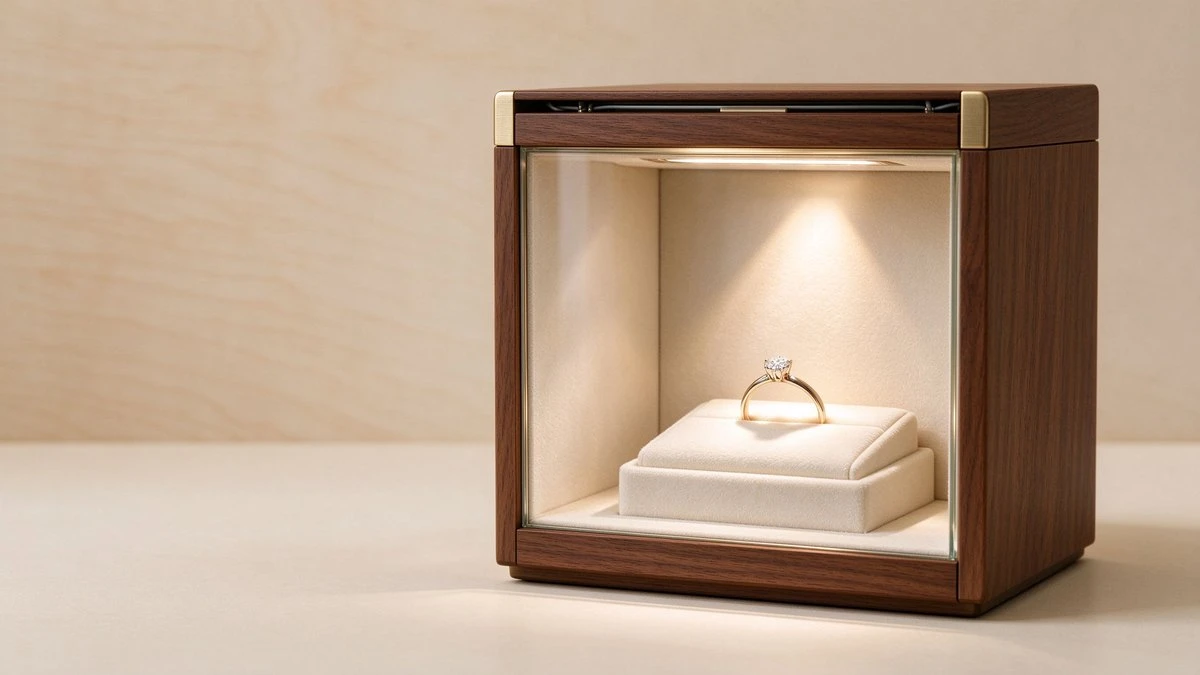
An island vitrine or wall niche 1.8–3.5 m from the door, deliberately off the straight-in path. Footprint 400×400 to 500×500 mm, top at 900–1,050 mm, so a standing customer looks into the piece instead of into a reflection. One hero item, two at most. This case turns "walking past" into "walking in."
Check two things: can you see it from the street, and is it bright against its surroundings? Aim for 800–1,500 lx inside with ambient nearby at about one fifth of that. Contrast is what a passer-by registers.
The usual failures: five bracelets on the hero deck, which reads as stock rather than a proposition, and a top above roughly 1,050 mm, where you end up displaying glass.
Zone 3 - Main display area: where the money is made
Mid-floor to deep floor, on the side where staff can stand and work. Transactions happen here, so this zone gets the most linear meters. Service counters: tops at 900–950 mm, depth 500–650 mm, a glass box 350–600 mm above the deck, tray spacing 15–20 cm. Leave at least 900 mm behind the counter (750 mm is the floor, not the plan) and 900 mm for customers in front.
Two mistakes: counters deeper than 650 mm, where the rear tray is unreachable during a fitting; and a full perimeter of wall cases eating the counter run, since wall cases store inventory and counters sell it.
Zone 4 - Try-on zone: mirrors, a seat, light from the front
At the end of the main counter run, or an alcove off it. Nobody buys a ring from a tray; they buy it from a reflection.
Set the mirror center at 1,050–1,150 mm above the floor: seated and standing eye heights differ by about 400 mm, so that serves both. Drop the seat 40–50 mm below counter height, which puts the customer at tray level. Light the face from the front and slightly above, never straight down: overhead light shadows the eyes and nose, and customers leave sooner than they can explain why. For necklaces and earrings, allow a full-length mirror at least 300 mm wide and 1,200 mm high, angled away from the case, or your lighting lands in the customer's eyes.
Zone 5 - Counter: add-on sales and the pick-up path
Two jobs share this corner, and stores usually design one. Add-on sales live at chest height within arm's reach of payment: care kits, small leather goods, a piece under your entry price. Collection needs its own counter face, to the side or rear, with a writing surface of at least 300×200 mm and a lockable inner drawer for the item handed over. Put a low impulse case beside the register.
Mistakes: pick-up inside the flow, so a customer collecting a resized ring crosses the whole room; or no pick-up face at all, so transactions and collections fight over one square of glass.
High-after-sales stores: keep the service path out of the sales path
Where you run engraving, resizing or repair in house, the pick-up path must not cross the main display area. Keep the collection counter behind the register line, to the side or rear, with its own path at least 900 mm wide. That corridor costs sellable wall, and it is cheaper than a showroom of people who came for a ring and left without a conversation. For intake, a lockable inner drawer keeps a customer's piece out of an open tray while you write the ticket. According to our inquiry records for the first half of 2026, buyers who specified a side or rear collection counter were mostly stores running their own bench.
Which vitrine for which category
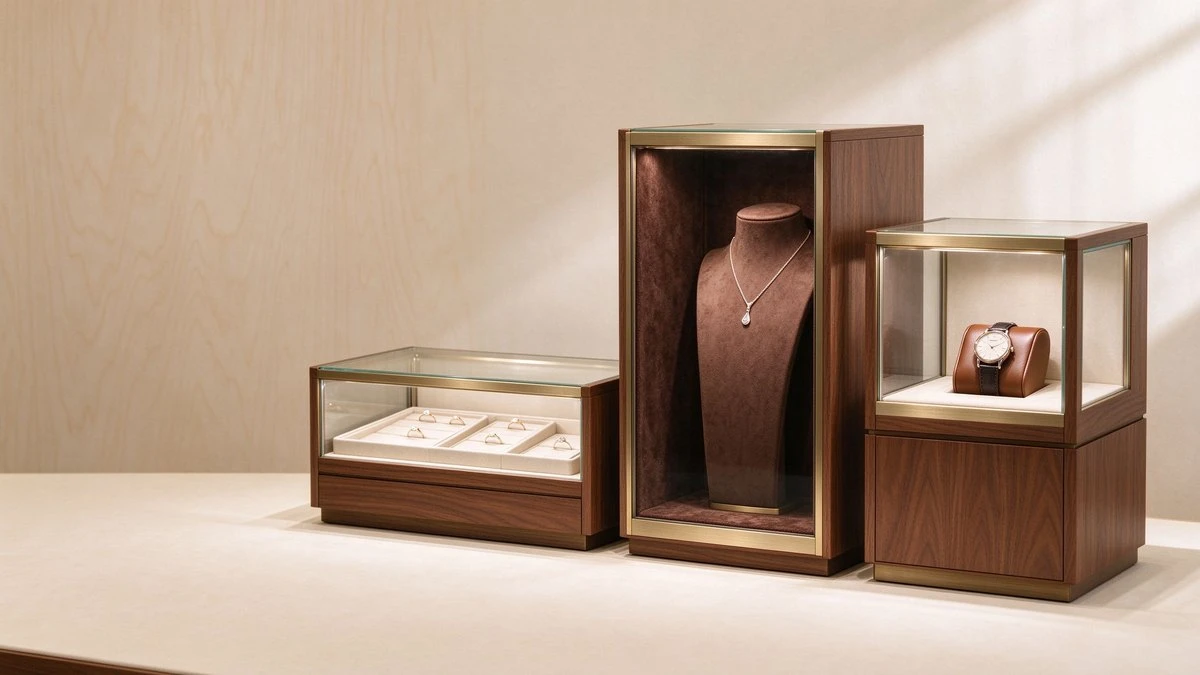
Rings, necklaces and watches need three different pieces of furniture. Clear height, tray style and lock position all move with the category. Figures are recommended practice; confirm them with your case maker.
| Category | Suggested shelf height / spacing | Interior light | Color temperature | Lock arrangement | Common pitfall |
|---|---|---|---|---|---|
| Rings | Trays 60–80 mm deep on angled stands; spacing 15–20 cm | 1,000–1,500 lx | 3,500–4,000 K | Drawer bank under the deck, concealed cam lock in the drawer front | Deep trays and flat inserts bury the stone, so you display metal, not fire |
| Necklaces | Bust or half-form, clear height ≥45 cm | 800–1,200 lx | 3,500–4,000 K | Lock hidden under a removable deck | Velvet on velvet: a dark chain on dark lining vanishes. Use a contrasting lining or a raised edge |
| Watches | One pillow per slot at 12–15 cm pitch, clear height ≥25 cm | 500–800 lx | 3,000–3,500 K | Central lock plus per-slot dividers | Narrow bezels turn point light into glare. Shield the source; consider low-iron or UV-filtering glass |
On locks: if one counter run carries more than four key numbers, staff feel it every shift change. If glare is the problem rather than lock count, our notes on professional lighting design for retail display go deeper into beam angles and shielding.
Three details that cut cost in service-heavy stores
Openable back panel. Staff change a tray from behind instead of reaching through the glass box. Restocking a 3 m run goes from fifteen minutes to four, glass gets knocked less, and the customer-facing side stays untouched during service. This is the item most often value-engineered out, and the one that pays back fastest.
Modular shelf inserts. One slot pitch (32 mm system-hole spacing is the common approach) lets you move from rings to bracelets without changing cases. Specify one shelf standard storewide, with the same hole pattern on every case in the order.
One key system. A single key removes the key ring and the lost-key panic. Master-keyed cylinders cost more and need a key register; full electronic locking is rarely justified in one store. Fix cylinder bore and face-plate dimensions at order stage, because merging key numbers later is a re-production job.
Layout sizes you change with a drawing. Lock positions and cylinder specs you change with a saw.
FAQ
What is the minimum aisle width for a store with service counters?
Recommended practice: 900 mm behind the counter and 900 mm for the customer. If you must reach a rear tray while someone stands at the glass, 1,050 mm on the staff side is safer.
Can an open display still be safe?
Yes, if you split the range rather than the room. Sturdy, easy-to-replace pieces go in the open area; anything with a pendant or a stone, or above your own threshold, stays locked. A common industry practice is to keep everything above JPY 100,000 behind glass. Pair it with lockable inner drawers and a staff position that covers the area.
The case is bright, but why does the jewelry look dull?
Check three things in order. Color temperature above roughly 4,500 K makes metal gray and gold pale. A source under CRI 80 flattens reds and greens. And a visible source: when the reflection meets the customer's eye line, they see their own face floating over the ring. Use a shielded or louvered fitting, aim the beam at the tray, and hold 3,500–4,000 K inside.
Next step
Want this on one printable page: five zones, the category table, lock and light numbers? Request the Jewelry Display Case Category Selection Sheet (PDF) from Mabolo Display, then send your floor plan through the inquiry form and we will return it marked up.