


At a Tokyo hall in spring 2026, the busiest booth near us was not the one with the biggest sign. It was a low wooden case, knee height, with four people leaning over it while a maker explained from behind. They were looking into a tray at one necklace on a lining the color of weak tea. Then a visitor touched the edge of the opening instead of glass. That told me what the queue was for: the case had stopped being a barrier and had not become a risk.
Four directions, and what changes in your next order. This is a floor report, not market research; figures come from our inquiry records for the first half of 2026, and light and dimension values are recommended practice.
Four directions we kept seeing
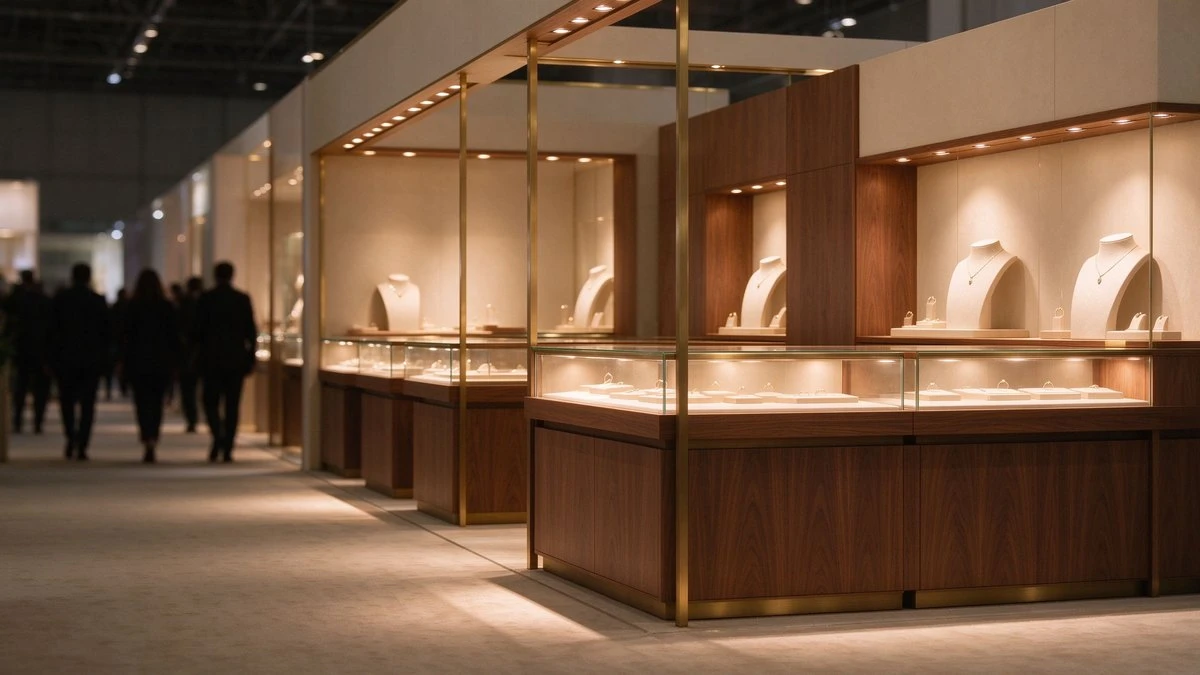
1. Lower cases and open display - security from the structure, not the glass height
What we saw. Waist and knee-height cases replacing tall vitrines on main floors. Product within hand reach, a salesperson close enough to touch the tray. Several booths had no glass across the front, and a shallow well instead of a flat deck.
Why. A customer who can hover a hand over a piece tries it on more often, and trying it on converts. Height was a security answer borrowed from museums, and jewelry retail is not a museum: most shrinkage happens at the counter, not through a window. So safety moved into the structure: a recessed tray the hand cannot sweep, a case that cannot be lifted off its base, a lockable drawer bank under the deck, and a staff position covering the area.
For procurement. Specify well depth and tray lip, not just case height. Industry practice puts a shallow well around 60–80 mm with a small return lip; that detail is what lets an open case stay open. An open case with no staff sightline is an unsecured case.
2. Modular and demountable - because the shop changes
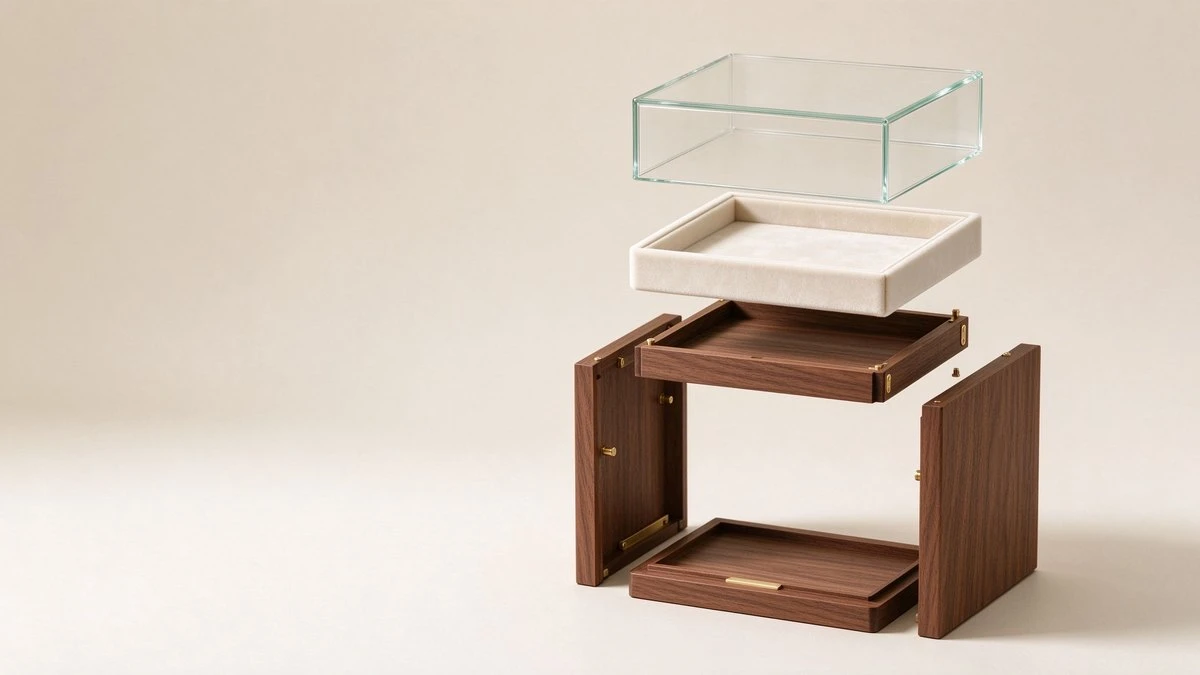
What we saw. Cases bolted rather than glued, shelf inserts on one slot pitch, glass tops lifted off by one person, and two booths showing a case dismantled on a table like flat-pack furniture.
Why. Japanese floors are small, rents high, and a lease cycle often brings a second site, a moved entrance or a category change inside three years. A bolted case travels. A one-piece carcass becomes rubble when the plan changes.
For procurement. Ask what fastener is used and whether it stays reachable after the deck goes on, and whether one slot pattern runs through the order: 32 mm system-hole spacing is the common approach, and it makes trays interchangeable between case types. Price shipping into the decision: knock-down costs more asseMaboloy labor and much less freight and transit insurance.
3. Invisible lighting - you see the jewelry, not the fitting
What we saw. Very few exposed sources. Linear wall-wash behind a shadow gap, small points hidden under a shelf lip, no LED dot visible on the glass. In one booth I moved side to side hunting the source of a ring's sparkle and failed.
Why. A visible source is a reflection, and a reflection competes with the product. Once LED replaced halogen, the fitting shrank enough to hide. The question moved from how many lights to where light can come from unseen.
For procurement. Specify the beam target, not the fixture count, and ask what the source looks like from a standing customer's eye line. Recommended starting values: 500–1,500 lx depending on category, 3,000–4,000 K, high CRI (our spec is CRI 95+), shielded or louvered. Then demand a mock-up in the actual lining. Lumens mean nothing once velvet absorbs them. For the lighting build itself, see our lighting design notes for retail displays.
4. Materials with a story, and the story must be traceable
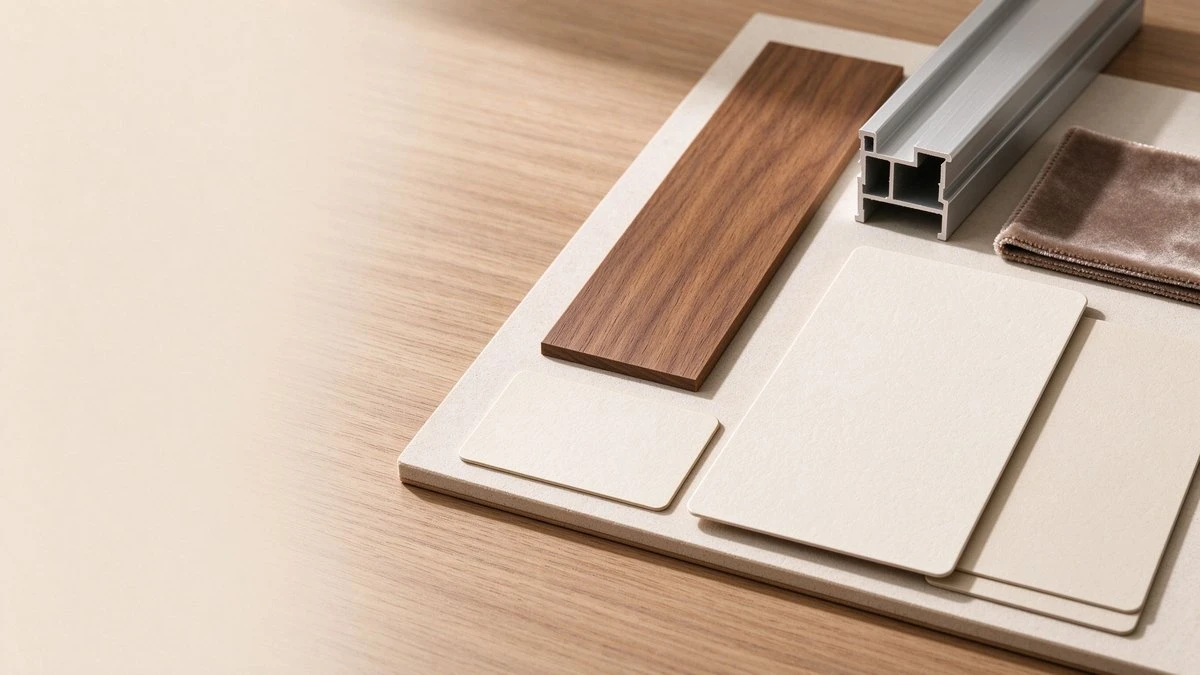
What we saw. Sample boards at booth edges: walnut veneer with a certification card, recycled aluminum beside anodized extrusions, velvet swatches labeled with a recycled percentage. More boards than two years ago, and more with a document number on the back.
Why. Retailers get asked about materials by their own customers, and by landlords and mall operators. A claim with no paper behind it is now a liability, so the conversation moved from "is it sustainable" to "can you trace it."
What Japanese buyers now ask about FSC and GRS
Our inquiry records for the first half of 2026 show most certification questions came from Japanese and European buyers. Three repeat.
Does the certificate cover the whole case or only the board? A panel-level certificate proves where the wood came from. It does not automatically cover frame, runners, finish or packing. Ask which components sit inside the scope, and get that in writing.
Can you provide chain-of-custody evidence? This separates a claim from a sticker. Chain of custody tracks certified material through each handover (mill, processor, fabricator, shipper) with certificate numbers at every step. Without it you have a supplier who says the wood is certified; with it you have a trail your own customer can audit. Ask for the code and validity dates, then check them against the issuing body's public register. Two minutes, and the only verification that costs nothing.
What percentage is recycled content, and on what basis? Recycled aluminum and velvet are usually discussed as a mass fraction of the input stream, but the denominator varies: whole product, component, or one layer. Ask which, and want the certificate figure, not the marketing one.
The two certificates do different jobs. FSC answers a forestry question: was the wood harvested under managed conditions and kept identifiable through processing? GRS answers a content question: how much recycled material is in this product, and can the chain prove it? GRS also carries chain-of-custody and labeling requirements, which is why a "made with recycled velvet" claim needs it. Neither substitutes for the other: certified origin does not make a material recycled, and recycled content says nothing about forestry.
We hold both. Mabolo Display puts certificate codes and validity windows in the order documents rather than in advertising, because the paperwork is the deliverable. A certificate is not a sticker: scope, expiry and transaction evidence are what survive an audit, and all three can be checked before you order. Our earlier report on display case materials shown at Milan Design Week covers the same shift from finish to proof.
Inquiry self-check: 5 items before the RFQ
- Scope in writing: which components sit inside the FSC or GRS scope, plus certificate code and expiry. Ask before you compare prices.
- Traceability phrased as chain of custody: not "is this certified" but "which certificate numbers cover each handover through delivery."
- Recycled content with its denominator: per product, component or layer, and the material named specifically: a textile type or alloy grade, not "eco."
- Modularity as fasteners and slot pattern: which joints are reversible, whether one shelf standard runs across all case types, whether panels are stocked by part number.
- A mock-up in your real lining: target lux, color temperature, and where the source sits against a standing customer's eye line, tested on actual velvet or lacquer.
FAQ
Does an FSC-certified case cost more, and by how much?
Certified board usually prices above uncertified stock, and the gap moves with supply. The larger cost is not the panel: it is keeping the certified stream separate inside a workshop that also runs uncertified work. Ask for the certified grade as its own line in the quote. We cannot quote you a percentage honestly, but we can quote a certified specification.
Can I buy FSC-certified wood and GRS-certified velvet separately?
Yes, and that is how it usually works, since they cover different materials. Each claim needs its own scope and each must be verifiable. Do not let a supplier merge them: "sustainably made case" proves nothing, while "FSC-certified carcass, GRS-certified lining at X% recycled content" can be audited.
How do I verify a certificate without calling the supplier?
Issuing bodies keep public registers. Take the code and the supplier's legal entity name from their document, look up the code, and check three things: the scope covers the product group you are buying, the status is active, and expiry falls after your delivery date. If the code is not on the register, ask for the issuing body's confirmation before you go further.
Next step
One document covers material options and certificate scope: the 2026 Display Case Materials and Certification Brief (PDF). It lists wood and metal choices, recycled-content claims, FSC and GRS scope questions, and the wording to put in your RFQ. Request it and we send the version matching the case types you are quoting.